
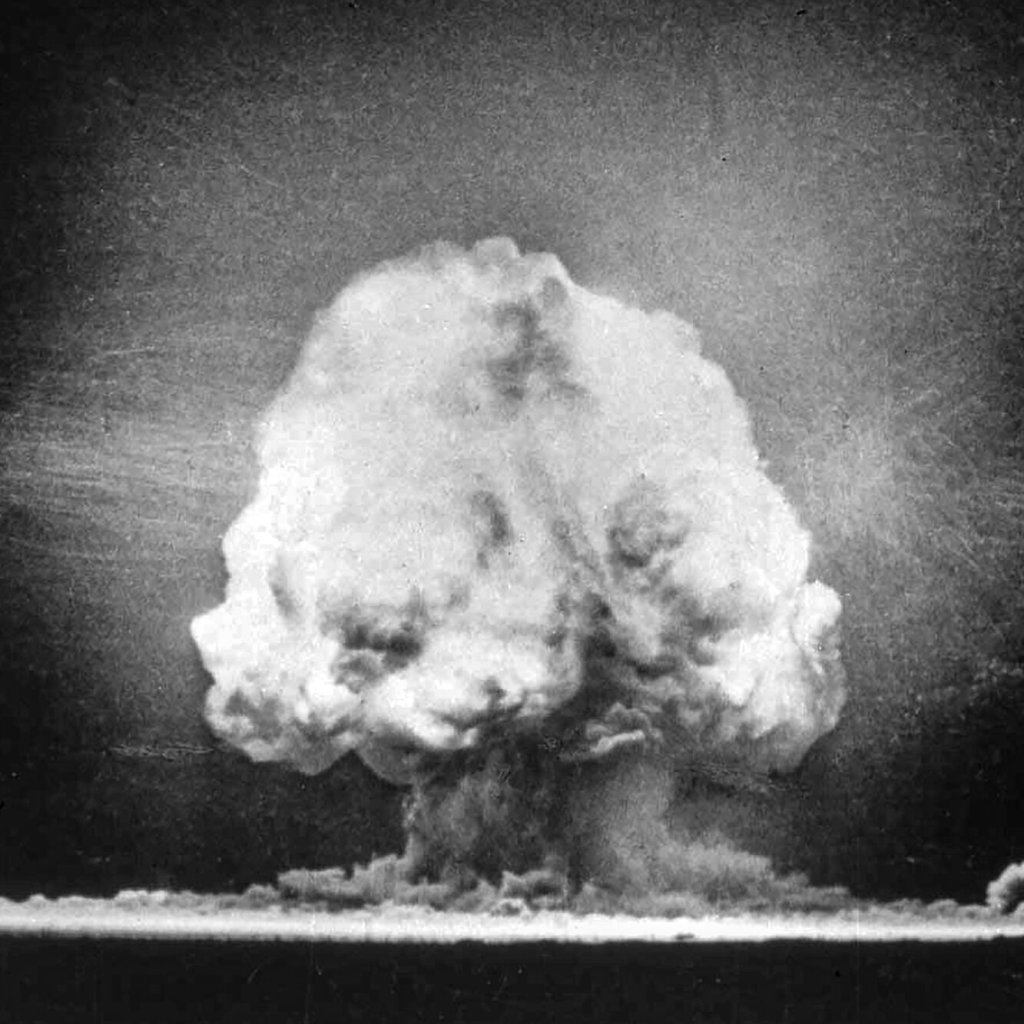
Public opinion holds that the Non-Proliferation Treaty for nuclear weapons is wise and just; that the fewer states possess nuclear weapons, the better – and that perhaps it would be best of all if no state possessed nuclear weapons. And yet for some reason, back in 1942 when these weapons didn’t exist – when, in fact, it was in question whether their development was even physically possible – everyone was in a such great rush to develop them then. Few were asking then whether it might be better to let sleeping nuclei lie (contra Hollywood, retconned moral reluctance for political reasons doesn’t count). What changed?
US supporters sometimes claim that the US only developed nuclear weapons because they were afraid the Nazis were going to develop them first. Historical analysis bears this out for the first part of the war and the initiation of the Manhattan Project, but it is clear that well before the final bombs were produced, US intelligence operations in Europe (specifically Alsos) had concluded that it was impossible that the Nazis had developed – or were indeed anywhere near developing – any such weapons. Yet the US continued their own program, even as the justification for doing loosed its hold on the riverbed and went floating down the stream. The next American argument is that these weapons were necessary to bring an end to World War II without excess American deaths. But such a justification could be used by any country engaged in any war. Why then do the Americans deserve nukes to prevent excess deaths among their soldiers, but not, say, the Congolese?
“Well, everyone can’t very well be allowed to have them. Of course, no one is going to be able to pry the nukes out of the hands of the superpowers, but still, there have to be limits.” But – why? Because when everyone is super, no one is? (And even if every country had nukes, would that really take much status away from the superpowers? There are many more difficult-to-produce weapons that only a few nations have, such as nuclear submarines or aircraft carriers – and these also more truly distinguish “real” superpowers from the rest, since unlike the superpowers, lil dictatorships like the DPRK don’t have them.) What is the real theoretical argument against a nuclear world?
“If all countries just got rid of their nukes, we could go back to the good old days.” Oh yes, the good old days: when every man, woman, and child in conquered cities were killed, not en masse by explosives, but stabbed to death one-by-one with swords. Consider an analogous problem – why not just go for total global disarmament? Let’s say every country makes a big stack of all their weapons and disposes of them through US 40 CFR Part 264 Subpart X waste disposal methods. Why not? After all, everyone having no weapons is just as good an equilibrium as everyone having equal weapons for deterrence purposes in preventing war, right? The problem, of course, is the same issue that plagues anarcho-capitalism; and even in Rand’s fantasy the anti-government, anti-military anarchist dissidents are by necessity the ones with the most advanced weapons (I’m betting some of the holograms in that Colorado valley were hiding big ol’ batteries of RPGs, but maybe they went for ATGMs instead, idk). In a situation where everyone has no weapons, what would immediately happen is some country would realize they wanted additional territory or resources, find diplomatic means insufficient for their purposes, and say, “Alright then, what do I need in order to take it by force?” Of course, this country would have no weapons now, having given them up – but the target nation is also equally unarmed. So all this ambitious country needs to have a major advantage in any ensuing war is a little bit of weapons. And assuming in this scenario no one got rid of their machine tooling (which is useful for producing lots of non-weapon technology as well), it doesn’t take much effort to build up a little bit of weapons. And then this country gets to conquer all its disarmed neighbors unopposed (“When the Cambrian measures were forming…”). Thus, the temptation to make just a few weapons and then start a war is very strong, because the cost is very low, and the potential benefit very high. On the other hand, in a situation where every country has a lot of pre-existing military buildup, if some country wants to start a war, they are going to have to spend a lot of money to make a lot of weapons to compile enough asymmetry in military strength for them to be secure in winning, especially if they are concerned about keeping their losses down. High certain cost and low potential benefits mean this latter equilibrium is stable, while the former is unstable. Ergo, military buildup is a positive social good. Q.E.D.
If this equilibrium situation applies to conventional weapon buildups, why should it be any different for nuclear weapons? “But what if terrorists got them?” You know the US sells F-35s to its allies, right? What if terrorists got those, eh? “Well, the countries that get those look after them pretty carefully.” Oh, so they’re careful with their planes, but careless with their nukes, is that right? Those they leave lying around in unlocked garden sheds? If China and Russia get to supply their allies with nuclear weapons, the US should do the same. The strong do what they must, the weak suffer what they are able. The US should choose to arm its allies rather than suffer global insignificance as its enemies proliferate what the west stingily chooses to hoard. Bounty shared is bounty grown. “But even General Groves thought the US should not be quick to share its nuclear research with France, or even the UK.” That, as he discusses at length in his book (Now It Can Be Told), is not because he didn’t want those countries to have nuclear capabilities per say – he trusted that they were US allies then and in the future. What he didn’t trust was their counter-intelligence measures against the Soviets, a prediction that quickly proved accurate as their governments leaked information into the Soviet East like sieves (not that the US necessarily did much better at times, despite General Groves’ best attempts at imposing opsec). If you want to prevent the spread of “classified nuclear plans” nowadays though, I’m afraid you’re six decades too late. Now, the major roadblock to making a nuke is gathering enough uranium or plutonium, not the design process itself, so infiltration by enemy agents is less of an issue (provided you have enough border security to prevent people from walking across the border with 20 lbs of plutonium (this is easier than it sounds, since walking around with enough shielding not to get cooked by said plutonium is pretty noticeable, and if you forgo the shielding, well, the problem solves itself)). Given that, why should the US not trust their allies with their precious radioactive balls? After all, is a friend that you don’t trust to pick you up from the bar really a friend? Is an ally nation that you don’t trust to have nukes really an ally?
The reason US “soft power” controls the world as an imperial domain is largely because the US is the only country with 11 aircraft carriers – but also because it is one of the few countries with nukes. If a return to classical international law, and true independence of nations (getting “recognized” by the UN for a country to be considered “independent” is the greatest oxymoron of the 21st century) – if such a return is desirable, as many isolationists even within the US believe, then one of the few ways to do it is to allow allies to begin military buildups – including of nukes – so that they can follow their own policies as determined by internal motives and not external tentacle nudges by Washington.
This is the US second amendment writ on the scale of global politics. If you cannot or do not have the weapons to defend yourself, you cannot be independent – or sovereign. It is hypocrisy for the US to say “we are allowed to have nukes, but not you, and that makes the world free,” when their own constitution recognizes that US citizens must be allowed to have weapons or they are not free.
This same logic applies to any other nuclear country’s allies as well, of course. “But then Russia and China will arm their allies with nuclear weapons too!” You mean their other allies besides North Korea and Pakistan? But more to the point, so what? Arm your own allies with more, then. A post-buildup world will result in an equilibrium more stable than the pre-buildup unstable equilibrium that threatens to tip at any time. “But then rogue actors and terrorists will also build nukes!” The thing about nukes, is while they’re perhaps less expensive than nuclear subs and aircraft carriers, they’re not that much less expensive. In a buildup situation, the countries with the most buildup are the ones with the most resources available – i.e., the richest – i.e., the ones with the most to lose if a nuclear war does break out, and the most interested in engaging in diplomatic or other means to prevent such a war. Look at North and South Korea. Despite the North dumping a higher share of its GDP into defense spending, it has wound up with a more poorly-equipped military than its richer southern neighbor. But South Korea has very nice cities to lose, and thus will likely never start a war on its own, even though it has the better military. This is what I mean by a stable equilibrium.
And of course, the final argument for nuclear buildup is that though nations fight, at the end of the day, we’re all human. And when the aliens come, they will come from far away, with perhaps fewer ships, but very high-tech ones. And the question will be, does humanity combined have enough nukes to wipe them off the map of the solar system? Or will Earth become yet another fallen tree in the dark forest? The way forward is clear – Build, Baby, Build!
 Literal Explanation Required