
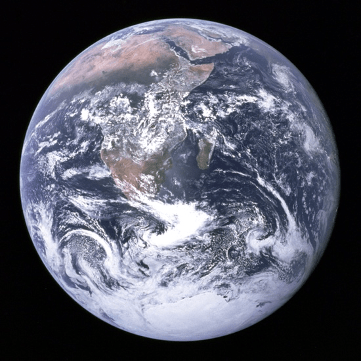
Is this the best of all possible worlds? Only in the sense that is also the worst of all possible worlds. The state of the world today is the exact result of all the forces of productivity, reason, and goodness striving for improvement countered by all the forces of incompetence, chaos, and evil working against them. “It could be so much worse” is just as true as “it could be so much better” – the only difference is which set of forces you choose to subjunct away as if they were somehow less real.
But for the most part, what people really want the answer to is the latter framing – why isn’t the world better? Why must everything suck so hard all the time everywhere? Even in rich, glorious, imperial countries like the US?
First, I’d like to note where this analysis falls on the is/ought dichotomy. It is easy for people to say the world ought to run better, that things ought to be cleaner and faster and cheaper and more efficient. It is far more difficult to make the world actually run that way – to transition the desire from the ought-state to the is-state. And trying to bring about an ought-state without first recognizing the is-state, to change things without first meeting reality where it stands, is an exercise in futility. Therefore, what I am describing here is not a judgment – it is merely a picture of the way things are. People have made their choices in the world in response to reality as they perceived it, and done what was best for them. My description of the results of their choices should not be read as a judgment, as if I were God reckoning up their sins by evaluating the net effects of their actions, but merely a recognition of the results those choices taken in total have led to. If you find these results undesirable, then perhaps it is possible to chart a path from here to the ought-world, but whether such a path exists is beyond the scope of this post.
Now, even a cursory look at history shows pretty clearly that it isn’t that things were good before but got worse. It was worse before. In fact, it was a lot worse, for most people, even all people, at almost all times in the past. The fact things are not very good right now is not an exceptional state of affairs. Going back even as recently as 1950, the child mortality rate in the US was 3.8%, versus 0.65% in 2023 (and that’s without considering the rest of the pre-1800 world). Estimates of US average working hours in the 1800s are between 60-70 hours a week, compared to around 40 hours in the late 1900s, and even less in the 21st century. People before 1885 didn’t have cars (because they weren’t invented yet), people before 1905 couldn’t take a flight (planes weren’t invented yet – though commercial air travel didn’t take off until even later in the 1950s), indoor plumbing in the US wasn’t widespread until the mid-1900s (that one was invented back in 800 B.C. by the Romans, but wasn’t standard in new-build houses in the US until the 1970s). And good luck getting a PC before 1970, or a smartphone before 1992. Though even if you had been able to obtain PCs and smartphones before the 70s, they would have provided somewhat limited utility given that the internet didn’t exist. Please remember (from your historical knowledge, or possibly personally if you’re clan MacLeod), that people used to wash clothes by hand, childbirth mortality used to be upwards of 1%, the victors in wars used to sack a city by murdering every man, woman, and child alive within (and sometimes also the animals), “modern medicine” used to involve humors and bloodletting (handwashing before surgery wasn’t invented until 1847) – the completion of the list will be left as an exercise for the reader.
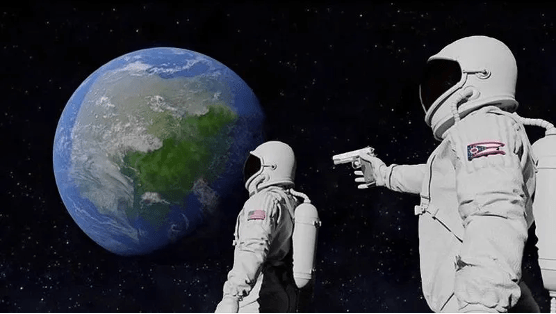
All the people who go around saying, “What exceptional times we live in! Pandemics! Wars! Politics!” – these people are idiots. In a 15-year-old, this mindset is excusable, since this is probably their first time old enough to notice the wars, pandemics and politics going on. But anyone older than 25 ought to know better. Anyone older than 25 who hasn’t noticed that all of this has happened before, and all of it will happen again, is at levels of NPC reminiscent of 1984. I am tempted sometimes to give them the benefit of the doubt and imagine they’re just LARPing as 15-year-olds, saying to themselves, “Just let me pretend that it’s my first time experiencing the world, as in the days of my youth, when I still believed in my heart that I was actually important!” Alas, I think most people are just idiots with the long-term memory of mayflies; especially since this modern-times exceptionalism is easily disproven by reading pretty much any history. Again, this ignorance is forgivable in a high schooler, but in anyone over 20 almost implies illiteracy.
And yet, just because the world sucked in many ways in the past does not imply that it should still continue to suck now. After all, humanity has more history and population than ever before, and thus more social, technological, and human capital accumulated than ever before. After thousands of years and billions of man-hours, shouldn’t everything be closer to fixed by this point?
But perhaps our continued troubles stem from but a single source (and as Serwa points out, this in no way implies the problems are therefore trivial). What is this source? I think Osho says it best. Democracy (and under American imperialism, everything is democracy) is government of the people, by the people, for the people, but the people… The problem isn’t that not enough people are working on the problem. The problem is that all the people working on the problem are idiots. The quantity of the work doesn’t matter much when the quality of the work is – such as we observe.
But there are a lot more people now. And by sheer statistics, a lot of those people are quite smart. And don’t those people all have a lot of reason to work on fixing the world, since after all, they have to live in it with everyone else? Indeed, there are a lot of people, and some of them are quite smart – though fewer by far than we all like to pretend. But these few smart people are not actually the ones working on the problems.
Let me explain. First, how smart does a person have to be to meaningfully improve the world? “Meaningfully” here means, capable of making some actually useful and functional invention, or of organizing a company/process/bureaucracy to physically make or improve something actually beneficial for people. Let’s use a nice, clean, objectivish measure for this – say, IQ. Start at the 50th percentile, 100 IQ. Have you met people around this level? Are they meaningfully improving the world? If they’re good intentioned and in a system that functions well, they might sort of break even, but…
According to The StudiesTM, people <100 IQ (US average reading level is “6th grade” according to the studies friends, but by personal experience this also checks out) – can’t read and comprehend a Dickens novel, can’t solve a basic differential equation, can’t code a bubble-sort algorithm (even in Python). But it’s a big country. Lots of people still can do these things. Isn’t that enough?
Nope. Not even nearly. Basics are not enough – never were enough – reading a Dickens novel does not make you Dickens, and knowing a little calculus does not make you John Von Neumann. Plainly put – you can do all these things and still be stupid. Even rocks can do these things (with enough finessing with machine tools).
In fact, rocks can or soon will be able to do almost everyone’s jobs. A typical response to people complaining about being replaced by AI, is that if AI can replace them, they must not have had a “real” job. Yet, won’t someday AI be able to replace even “real” jobs if it improves enough? So we might as well double down. If AI can do it, it wasn’t a “real” job, full stop. “AI can flip burgers!” No one ever thought the food service jobs were real. “AI can replace accountants!” I though excel already did that? “AI can replace journalists!” Only the politicians ever a considered that a real job in the first place. “AI can replace senior marketing slop executive vice presidents!” How tragic. “AI can replace teachers!” Individually tailored education will solve so many issues, from student boredom to disparate impact issues (there’s no point in arguing about group outcomes once everything is individualized), that it can’t come soon enough, but that’s a whole other topic. “AI can replace garbage men!” Did anyone actually like picking up garbage? “AI can replace my software job!” App developer and B2B SaaS engineer sound like online gamer handles. “AI can replace weapons manufacturers and designers!” If only, if only. “AI can replace politicians!” Nowhere to go but up. The jobs AI will replace all deserve to be replaced because “job” is not a natural category and men were not made for them. The only “natural” jobs are childcare and agriculture, the former of which is going away no time soon for reasons that have nothing to do with productivity or token generation, and the latter of which was replaced long ago in the earlier rounds of industrialization.
There are jobs out there that AI cannot replace, perhaps will not be able to replace at all until ASI is totally achieved, but these are not “jobs” in the same sense as what you find posted on Indeed. The people doing these jobs are people you rarely meet because they are busy actually running the world (or else tucked away in private mansions for reasons I will come to shortly). If AI can do it, it’s a slop job. AI can do all jobs on Indeed. All jobs on Indeed are slop jobs. Q.E.D.
Then, is AI capable of fixing the world? Well, how’s it doing so far? Not, I think, any better than the people in the slop jobs were doing, at least when it comes to quality – quantity being another matter where the rocks perhaps have humans beat. But after all, it is mostly only taking the jobs where a college degree is enough qualification – and a college degree (college graduates at one time averaged 115 IQ) is not nearly enough to indicate someone capable of fixing the world. I mean, have you met college graduates? But then when we go on to consider even 130 IQ Atlantic writers, 135 IQ physicists with their spherical cows, 140 IQ model train guys…we have met these people. We have seen their apartments (or at least pictures of their apartments in the Atlantic articles). They are not rewriting the Akashic foundations of the world.
So, how much IQ is enough to fix the world? Unfortunately, I don’t know the answer. I can, though, give a floor.
The SAT correlates with IQ tests somewhere between 0.5 and 0.9, so take that as a proxy. From personal experience, I got a 1600 on the SAT if you just count reading and writing portions. (“But everyone on the internet claims they got a 1600 on the SAT!” Uh, it’s not that hard, maybe they all actually did.) Now, I am not smart enough to meaningfully improve the world in any way. If I had to guess, I would say my level of intelligence is not even close to the level needed to make meaningful improvements – though of course my judgment of that isn’t perfect, since it’s harder to see up than down when it comes to these sorts of things. So, you at least need someone who can score 1600 on the SAT. That’s a minimum. Bare minimum. Probably far below bare minimum, really.
But wait, that’s not the worst of it. Now comes the most distressing bit…if you’ve been living under a rock for the past 50 years.
Because even if the minimum threshold is high enough to exclude the vast majority of humanity, there still exist a few actually capable people out there. After all, the world as we know it today was produced somehow, which means humanity periodically generates the Übermenschen necessary to build society, even if in numbers too low to make a dent in fixing the problems with said society. Surely, these capable few are working of the problem of fixing the world, right? Even if there’s only a few, given enough time they’ll still make steady progress, so the world is going to eventually get fixed, right? Slow and steady wins the race, after all.
Lol. Lmao, even. No, these people aren’t working on fixing the world. These people are doing one thing, and one thing only – quantitative trading. They’re all hedge fund managers or investment bankers, multi-billionaires with private mansions, etc. They aren’t fixing the world, because they don’t need to fix the world to make it livable for themselves. They are smart enough to skim off the top of the systems generated by generations past. (Yes, financial markets can cause efficiency gains in theory, but making billions of dollars off of millisecond trades is long past the point where the practice might still have plausible social utility.) And after they’ve made their billions, there’s no incentive for them to keep working on anything that would meaningfully – in the sense defined above – improve the world. Ultimately, there’s no reason for them to scrape the skin from their face and peel their fingernails off trying to fix a world of the idiots, by the idiots, for the idiots. Tend your garden, and all that.
But what about the people just a bit below them? Surely, with the groundwork already laid by the generations past that built up the economic and social technology that the modern world runs on, even a midwit could at least make incremental improvements?
If it was too much work for the actual Randian Übermenschen, how much more too-much-work must the task be for the almost-hardlys, the Eddie Willers of the world? Impossible. These people either decided it was better to pretend to rule in hell than be the service employees of heaven, and went into politics – or they decided to skim the less lucrative way, and dump the obligatory hours of their lives into making powerpoints (or spreadsheets, if they were “math people” who did a “STEM degree”), sending emails, and other bureaucratic busywork, and filling the remaining office downtime with a mix of online shopping and chatting with friends. (As many have pointed out, you can’t “shut down” the economy for a year without societal collapse unless “the economy” was not doing as much necessary economic activity as one might have previously assumed.)
So, then, what is keeping the things people like – roads and houses and the grid and the food and the plastic widgets and the hospitals and all that – functioning? Or rather, who?
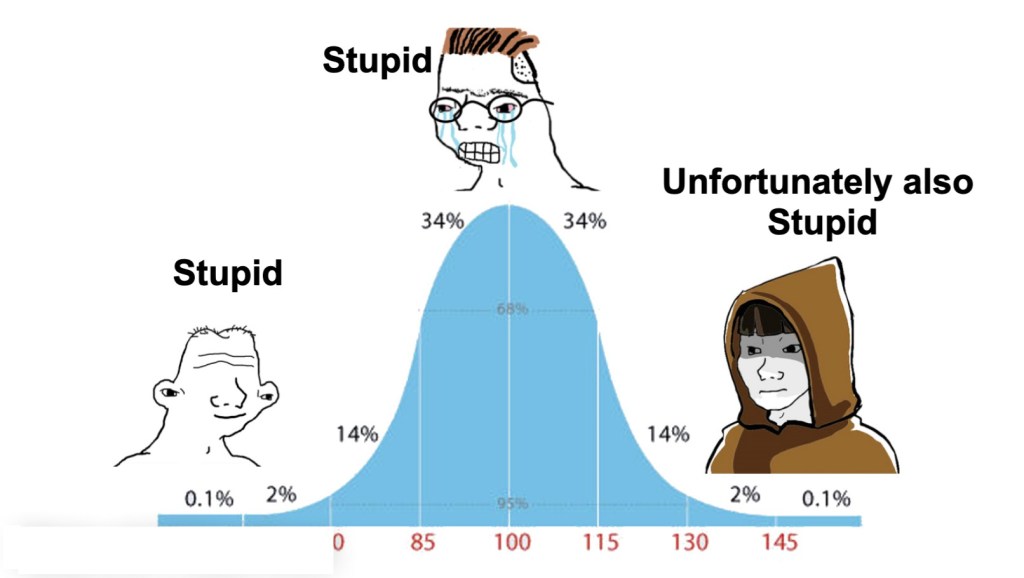
Well, it’s not the hoodie-wearers off the far right of the bell curve, since they’re tucked away in their mansions. And it’s not the 115 IQ midwits, since they’re tucked away in their cubicles or home-offices. So…
Indeed, the world is being operated by people with room temperature IQs. And you still wonder why the roads and the sandwich shops and the plastic widgets suck? The slice of the bell curve just high enough to keep out of prison but too low to merit an office that are left to do the work can’t even maintain what has been built so far, much less improve upon it. Incremental decay is the best that can be hoped for with such a state of affairs.
Now, this isn’t Idiocracy, mind you. The right side of the bell curve isn’t dying out. They’re there. They’re just doing their own thing. A fair few of them are having kids, too. Maybe someday they’ll even come back to tend the flock, if it gets bad enough. It hasn’t happened that way in other countries that got bad, because their right tail just moved to Europe or the US. But if even the “first world” decayed, and there was nowhere left to move to…though there are a lot of islands out there…and valleys in the Colorado mountains…though at least then the rest of us could take vindictive pleasure knowing our betters didn’t have the sagging wheel of the world to skim off of anymore.
In conclusion, everything in the world is garbage because it was made by stupid people, which make up 99%+ of total people. Short of widescale embryonic engineering for intelligence or eugenic mass extinction, this state of the world is not about to change any time soon. Evolution’s SAT score isn’t getting it into any Ivies. Have a great day.
 Literal Explanation Required