
The Truth’s superb surprise”
[Contains spoilers for The Thousandfold Thought (many), and The Judging Eye (a few).]
I.
Everyone wants things. Many of these things are mutually incompatible. Given this fact, what determines who succeeds in getting what they want, and who fails?
The answer is that the one succeeds who has the most power, almost by definition.
Power exists along a spectrum. Everyone has someone above them, and someone below them, except for two people. And only one of those two is worth being. Given that we cannot all be that other one – does that doom all but one of us to failure?
Clearly, no. Certainly, one might expect the person at the top to be the most successful in general. But this does not mean that they will be successful at everything – there are games enough in this world to allow for more than one winner.
How, though, can a person win the game of life, when he is not the most powerful player?
To win is to achieve one’s goals. To achieve one’s goals, of course, one must first have goals that exist and are achievable. Next, one must have the power to act to bring these goals about. But power alone does not suffice. One must simultaneously possess the understanding to know which actions will bring one’s goals closer and which will be counterproductive. The combination of these factors is agency. The execution of these factors is victory.
Is it possible, though, for someone possessing less power, less understanding, and less clearly defined goals than another, to yet achieve victory in any adjacent domain?
There are some reasons to believe this should be possible. First, not all goals are mutually exclusive. A more powerful player, who might be able to beat you easily head to head, may well have better things to do than come after you personally – in which case, so as long as you stay out of his path, you can move freely. Alternatively, if your goals align with his, this is better yet, as long as you remain sufficiently cautious. And then, while this more powerful player may have many players such as you opposing him and might be required to split his attention between them, you, choosing less far-reaching goals, might be able to focus solely on combatting this particular enemy, making you the more powerful in some limited sub-domain.
But in the end, such strategies are loose straw beside the bale which is power itself. Where, then, does power come from? Is it inborn through genetics? Inherited from ancestors? Achieved through effort? Given by the gods? Taken from the people? What really makes one player better than another?
II.
Considering the proposition that power stems gods, we may ask – could the source of power be divine? That is, could Kellhus be winning the game of Holy War because he is a prophet? Before that though, perhaps we should first ask – is Kellhus a prophet?
The answer, of course, depends on what we mean by the word “prophet”.
Certainly, much of what Kellhus does is calculated to make the men of the Holy War believe he is a prophet – so in this sense he is at least pretending to be a prophet. But just because he is pretending, must that mean he cannot also be a real prophet?
But what is a real prophet, in the world of Eärwa? Was Inri Sejenus a real prophet? Or was he only pretending, or mistaken?
There are several tracks we could follow to measure what makes a prophet real or false. First, we could call anyone a prophet who both claims to be a prophet and can gather sufficient followers who believe their claims. Second, we might define Inri Sejenus as the standard of what makes a real prophet, and judge others’ prophethood by their similarities with Inri Sejenus. The problem with this method is that since Inri Sejenus is a historical figure who died well before the start of the books, many details about him are far from clear. Or third, we could define a real prophet in the same way as the men of the Holy War understand it: someone inspired by the gods with a divine mission.
What about Kellhus, then? In the first sense, he certainly is a prophet, since he both claims to be one and amasses a large following by the end of the first series.
In the second sense, Kellhus’s status as a prophet is less clear. Certainly, he convinced the men of the Holy War that he was a prophet by attempting to replicate Inri Sejenus – but if Inri Sejenus were in fact divinely inspired, then Kellhus would not be able to copy that aspect without divine assistance (though he could obviously fake it – but that would only make him a false prophet according to the second sense, not a real one).
But suppose, whether divinely inspired or not, we believe that Inri Sejenus was not lying about his personal belief that he was a divinely inspired prophet. Then in order to be a prophet in the second sense, Kellhus would also have to believe he was a divinely inspired prophet. We can then ask – does Kellhus believe this? At the beginning of the series, almost certainly not, since he starts out with the full intent of faking prophethood – and if he believed he were a real prophet, one might assume he would not expect to have to fake it. After the Umiaki, though, his beliefs are harder to discern. Was he telling the truth, when he told Moënghus he saw halos around his hands? One wonders.
What, then, when we ask whether Kellhus is a real prophet in the third sense? For this to be true, there would (1) have to exist gods, (2) who are in some way communicating their divine intent with the prophet in question, and (3) the prophet must be acting in accordance with these communications. In this case, it does not matter whether Kellhus believes he is divinely inspired or not, as long as he is in truth. As in the first sense discussed above, Kellhus can be a real prophet while also pretending to be a prophet, as long as the three conditions are met. The first condition – that there exist gods – is certainly true (especially if we consider the fourth and later books, though the unquestionable existence of the No-God is surely proof enough). These Gods exist in the outside, and they can and do affect the world of Eärwa. Whether the second condition – that these gods are communicating with Kellhus – holds, depends on whether his visions on the Umiaki are real, but let’s assume for the moment that they are. Then, it only remains to ask whether the third condition is met – that is, is Kellhus acting on these divine instructions? If he is not, he is not a prophet in this third sense.
This possible lack of true prophethood, however, doubtless would not concern Kellhus very much, since prophethood is not his core claim to identity. Rather, Kellhus, in his own mind, is first and foremost a Dûnyain – conditioned. We know this because in times of stress, characters in Bakker’s novels, as do people in real life, fall back on their sense of identity – and “Dûnyain” is the identity Kellhus always falls back on (for example when losing it on the Umiaki, or when he goes to confront Moënghus).
There are other central identities, though, which we may ask the nature of. For example, those of two of Kellhus’s primary enemies within the Holy War: Cnaiür and Conphas. Conphas claims to be a god. Cnaiür claims to be a demon. Are either of these claims – true? And if so, in what sense?
III.
We ask whether a claim is true – but what is Truth, within Bakker’s novels? We will use a version of Bakker’s own metaphor – the Truth, we shall say, is fire. To walk the path of Truth, then, is to cross a burning bridge. But the thing about passing through flames, is – they sear you away with every step.
And yet, not to walk with the Truth, not to keep sight of deeper realities, is to doom one’s plans to failure, or at least to consign their success to the whims of chance or of one’s betters. How, though, can one walk the path of Truth without becoming ash?
For most characters in Bakker’s world, this is impossible. They walk other paths far removed from Truth, and what Truth they do encounter scorches them more than it benefits them. Kellhus tells his followers to “throw your face into the furnace!” – but unprotected as they are, they simply wind up burning their brains away, making room for Kellhus to place his own self-serving dogma in their soot-stained skulls.
But a few do manage to find strategies for passing through the fire. Conphas, Cnaiür, and Kellhus all have their own methods for gazing upon the bare nature of reality without being destroyed in the process – though some of them, as we shall see, are more successful than others.
Let us first take Conphas’s strategy. Conphas, desiring to walk with the Truth without being burned, does so by walking near the flames while shielding himself from them. To shield himself, he uses his narrative – by believing in the narrative, he is not burned by any truths he cannot comfortably fathom. For this to work, though, he must constantly adapt his narrative to keep it at least somewhat aligned with reality. At the beginning of the series, he trusts Martemus’s opinion enough to triangulate by it, which works reasonably well until Martemus falls to Kellhus’s influence. Conphas’s success in using this strategy is also helped by his hereditary political power and native intelligence, along with his ability as a psychopath to look directly upon certain truths others would flinch from. Together, these factors give him enough of an advantage over most of those around him to manipulate them and the world to fit his image. Unfortunately for him, there are others in the Holy War who have abilities and Truth-adapted strategies surpassing his, who are not so easy for him to affect.
Next, Cnaiür’s strategy. His approach is to advance toward the Truth head on and unprotected and face it until he catches fire, at which point he is forced to back off again. This method has certain drawbacks – for example, it tends to burn his memories away. It is hard enough to operate in a complex environment like the Holy War, without half the time having no memory of what one was doing yesterday, or the past week, or the past several months. Long, unpredictable blackouts put a real damper on the prospect of long-term planning. And yet, for all that, Cnaiür often has a better idea of what is actually occurring in the Holy War than even Conphas, speaking to the advantages of this dubious method.
Last, we come to Kellhus’s strategy. Kellhus simply walks in the middle of the bridge of fire, utterly unshielded. As a result, everything that made him human has long since burned away, leaving only a bare, fleshless frame that mechanically continues ever onward. Kellhus is no longer human, but Dûnyain. Thus, we see that Bakker is telling us that one can get as close to the Truth as one pleases if one is simply willing to sacrifice their humanity. This is why Kellhus is the most successful player in the Holy War – because the version of the world that he is looking at is closest to the Truth.
IV.
Another way to understand the varying degrees of success these characters find in pursuing their goals – that is, the measure of their power – is through the metaphor of layers of reality. Kellhus functions on a deeper layer of reality than everyone else, and thus is more successful. Imagine you were trying to write and compile a program in Java, and I were trying to sabotage you by making changes to the operating system of your computer. As long as I know what I’m doing, I’m probably going to win, because the layer I have access to is more fundamental. The conflicts within the Holy War, both open and hidden, can be explained in terms of such layers.
On the surface, the Holy War is a religious conflict between the Inrithi and the Fanim. Certainly, much fighting occurs between these two forces – but conflicts are not by any means confined to the interreligious. Often, too, the form and nature of their battles cannot be explained in terms of this layer of conflict alone. Political and personal conflicts between the Great Names spur some to attack in advance to gain glory, or others to hold back (such as the Scarlet Spires, which is completely uninteresting in any fighting not involving Cishaurim). And then there are those conflicts that cannot be explained by mere politics or personal grudges, conflicts that occur on a deeper level yet. Kellhus, Conphas, and Cnaiür, for example, almost always agree with each other on tactics (at least, when they all want the Inrithi to win). Political or personal issues account for some of their disagreements, but not all. While at times even the other leaders of the Holy War want Kellhus gone, Conphas is always willing to go further, and when most ultimately decide to ally with Kellhus after Caraskand, Conphas stands alone as the only cast-nobility holdout, because among them, only Conphas recognizes the true machinations by which Kellhus is taking control. Kellhus and Cnaiür have no political reasons for conflict, and while Cnaiür explains their animosity to Proyas as a personal grudge over Serwë, Proyas is always dubious of this story. Still, Proyas cannot find out the true reasons behind their dispute, because it is happening on a deeper layer than anything he is able to discern. And as for the hostility between Cnaiür and Conphas, they hate each other for reasons deeper than just the initial competition over the position of general. Of course, there is a deeper layer still than all this, the true conflict at the heart of the Holy War: that between the Dûnyain and the Consult. Both Kellhus and Aurang want to see the Inrithi march on Shimeh – but their motives for achieving this outcome and plans for what comes after are very different.
Each conflict takes place not only in its own layer, but stretching up through all the layers above to that of physical reality at the top. How many layers deep a character can manage is determined by how he thinks – that is, by what level he is. Conphas, Cnaiür, and Kellhus manage to gain more control over the Holy War than its nominative leaders like Gotian and Proyas, or even than those possessing more absolute firepower like Achamian or Eleäzaras, because they are higher level, and thus can function at deeper layers, rewriting the operating system as those above struggle to recompile their programs in a hostile and shifting environment.
But what determines who can operate on which layer?
First, we must recognize this little-known fact –
There are levels in this world; in Bakker’s world, as in the real world. Unlike in the real world, though, the levels present in any book are generally capped at the author’s level – authors being mainly unable to model characters with a higher level than themselves.
Each person or character has his own individual level, which reflects how he models and understands the world and makes decisions. Generally, people start as children at the lower levels, and then progress upwards as they gain age and experience, one mode of understanding of the world superseding another, with their ultimate level limited by their intelligence and the average level of their surrounding society. (This theory is based off of a book which I will link here when I find it again.)
In order, then:
Level one can be ignored.
A person at level two views the world in terms of reward and punishment. This is a fairly superficial view, without full models of other people’s motives or of social dynamics. The objective of a level two is to seek pleasure and avoid pain, and he judges others on the basis of whether they help him or hurt him. This level is very uncommon among adults, who fall mainly at levels three to four. Among the characters in Bakker’s novels, Serwë is at level two – her perspective on others is simplistic: she hates Cnaiür because he hits her, and likes Kellhus because he protects her. She’s also one of the few characters to actually beg (“Don’t be mean to me.”) – most characters in this world, even level threes, model others enough to recognize that pity does not move the denizens of Eärwa, and that in order to survive they must make their appeal in some more persuasive way.
A person at level three views the world in terms of relationships and feelings. He understands the concept of reward and punishment, but sees that there is something more, relationships, which take precedence over mere direct personal benefit or loss. As someone who views relationships as the highest level of meaning, he judges people based off how close to them he feels, and believes that people who inexplicably oppose and hate him can be brought around by sufficiently honest communication. He interprets events and evaluates people he meets based on his subjective emotional responses to these events and people. Although he can model relationships better than a level two, he still views them in a nebulous way that does not easily encompass hierarchy or allow for clear definitions of social relations. A level three desires to be understood by others, and generally feels that telling the truth and communicating more openly and honestly with others will lead to mutual friendship and understanding. Among Bakker’s characters, Achamian is level three – he wants to be liked by everyone, gets hurt feelings even when insulted by enemies like Eleäzarus, and generally outside of where he’s been trained by the Mandate to harbor suspicions, he trusts blindly. He likes libraries and desires knowledge for knowledge’s sake, because he has positive connotations about it, and not for any specific purpose. He goes into meetings with important contacts without any plan in mind, trusting that whatever he feels like doing at the time will work out – for example, in the first book when he meets with the slave from the Scarlet Spires, and later at his first discussion with Kellhus (not that a plan would have helped him against a Dûnyain, but the point remains). A few of the other leaders in the Holy War, such as Saubon, are probably also level three.
A person at level four views the world in terms of a single system of morality or framework of values. He understands relationships, but thinks of them as secondary to his system of values, and not to be pursued at the expense of following the latter. He believes in a clear right and wrong, and divides people into enemies and allies based on what side of his framework they are on. There might be many such systems a level four could follow, but he picks one (generally not consciously or reflectively, rather tending to choose whatever he inherits or is trained to) and makes it the guiding principle of his life. These systems are mainly not created by the level four himself, but rather accepted from some outside source, which he then learns and adapts to his own circumstances. A level four makes decisions by applying the values of his chosen system to any given situation. He seeks consensus and friendship among his allies, as a level three does, but unlike them he is also able to be pitiless to his enemies. He is able to lie, when it is in service to the cause of his system. He cannot easily be turned against his chosen system either, as a level three can be (note how easily Kellhus convinces Achamian to not report him to the Mandate, since Achamian thinks more of his personal relationship with Kellhus than his system-based obligations to the Mandate, which as a level-three he cannot fully internalize or accept). An example of a level four from Bakker’s novels is Proyas – he serves his religion, making it the guiding principle of his life, and generally can be persuaded to take an action if and only if he can be convinced that action will serve the religious cause. Many of the other leaders of the Holy War are level four as well.
A person at level five views the world in terms of narratives, which he creates and personalizes for himself. He understands relationships and frameworks of morality, but stands above them, viewing them as pieces to be used to construct a greater narrative. To him, people are no more than characters in this narrative – enemies could be beneficial, or friends unfavorable, depending on whether their presence is furthering or impeding the course of his story. He makes decisions based on what he thinks will most advance his narrative and goals.
The levels generally alternate, with even levels being levels of constraint and rules, and odd levels being levels of freedom and open-ended choice. Level five is an odd level, so a person on this level is not constrained by any single system of values, as a level four is. But a level five is also less constrained than a level three, in that he does not have to follow paths of emotional non-resistance, and can act against and above feelings and relationships, thus making his actions generally more effective in achieving his goals – which are also often much more concrete than the goals of level threes, thus making a level five more likely than a level three to achieve what he wants.
The two human level fives in the Holy War are Cnaiür and Conphas (Esmenet possibly starts as level five as well, but loses her momentum and narrative when she gets drawn into Kellhus’s plans). Cnaiür’s narrative is about a Scylvendi on a quest to avenge his father. Conphas’s narrative is about a commander great enough to be a god. As level fives, both of them have more resistance against being coopted into Kellhus’s plans than the rest of the men of the Holy War.
One distinct difference separating level five from level four is the ability to split one’s masks. That is, level fives in general have an “inner” personality and an “outer” personality, each with their own goals and nature. Ideally, if the split is done correctly, the outer personality will serve the interests of the inner, acting as a mediator between the inner personality and the outside world, and forwarding the inner’s interests. For example, Conphas’s inner personality believes itself to be a god. Conphas’s outer personality, though, denies this vehemently, claiming itself to only be an Exalt-General – and by doing so serves the interests and ambitions of the inner personality by not alienating potential allies.
Cnaiür has also split his masks; however, Cnaiür is an example of how not to do this. In Cnaiür’s progression through the levels, something goes wrong – that something being Moënghus. Cnaiür starts off, before he meets Moënghus, as a level three Scylvendi teenager. That is, he thinks of the world in terms of relationships and feelings. He is in the process of shifting his worldview to the structural framework of Scylvendi traditional values, but is not quite there yet when Moënghus comes along. Moënghus, to serve his own interests, power-levels Cnaiür, not from three to four, but from three to five. And as a result of skipping level four, Cnaiür never gets a defined enough sense of right and wrong and his own personal values before he splits his masks, choosing his inner and outer personalities instead based on Moënghus’s self-interested guidance. As a result, when Cnaiür starts to reflect on what he has done, he recognizes that his actions disagree with the values he actually aspires to – he realizes that he has chosen for his inner personality something which shames him, and he wishes he could be, entirely and undividedly, the person represented by his outer personality. But it is too late – the actions he has already taken cannot be undone. As a result, Cnaiür goes through life trying to live wholly in his outer personality. This does not destroy his inner personality, but merely leaves it to its own devices, with certain consequences I will come back to later.
A person at level six views the world in terms of discrete people, actions, and events that help or hinder his achievement of a single higher goal. Level six is a constrained and structured level, like level four, but this does not mean that the level six cannot model and understand the less-constrained lower levels – he can take feelings and relationships, systems of value, and even entire narratives into account in his calculations and plans. A level six is also more effective than a level five, because he is not bound by the need for any narrative or story, but only judges the desirability of an action based on whether it furthers his ultimate end or not, optimizing his actions to achieve his goals. He manipulates people, systems, and narratives without regard to any lower-level conceptions of ‘good’ or ‘evil.’ Unlike a level five, he generally faces no value tradeoffs at a high level, only tradeoffs of chance and advantage, since he pursues a single goal. The example from Bakker is obviously Kellhus.
We do not see anyone at level seven in Bakker’s books that I can discern – although this does not mean that no such level exists in the real world, only that Bakker’s world level cap is set by his own level of understanding.
V.
The result of all this is that as the highest level player, Kellhus’s plans tend to work where others’ get blocked. This is no more apparent than with Cnaiür and Conphas, who in a less complex world would probably be winning. Here, however, they are not. Kellhus understands and predicts them, and takes actions whose propagating effects ultimately lead to their falling under his control, or to their demise.
Kellhus manages this because he understands their relationships with truth and reality, and thus knows how to undermine them. This is clear from the scene in which Cnaiür watches Kellhus kick Conphas out of the Holy War. Understand this scene, and you understand Conphas and Cnaiür’s arcs entire.
This scene plays on the concept of overlapping narrative layers of reality, as Cnaiür notes after observing Kellhus carry out his cult-like initiation ritual:
For the Inrithi, the man had crossed an intangible threshold. They had watched a profound transformation, a base soul raised to the assembly of the elect. Where before he’d been polluted, now he was cleansed. And they had witnessed this with their own eyes. Who could question it?
But for Cnaiür, the only threshold crossed was that between foolishness and outright idiocy…
Unlike the Inrithi, he did not stand within the circle of the Dûnyain’s deceit. Where they saw things from within, he saw them from without. He saw more. It was strange the way beliefs could have an inside and an outside, that what looked like hope or truth or love from within could be a scythe or a hammer, things wielded for other ends, when seen from without.
After Caraskand, the whole Holy War stands within Kellhus’s ring of fire – the whole Holy War, that is, but for Cnaiür and Conphas, the only two level five humans therein who yet oppose him. They have their own narratives, their own circles, and their own ground, and thus they can resist being drawn into Kellhus’s. Therefore, for Kellhus to take full control of the Holy War, Cnaiür and Conphas have got to go. But at this point, both have appreciable backing of their own, not to mention innate cunning and personal malice towards Kellhus. Even so, Kellhus dares send them away – together. Is he not concerned that they might team up against him, and return to disrupt his plans?
He is not. As one who understands the bare machinery at the heart of reality, his control extends far beyond his line of sight. In the rest of this scene, Kellhus sets in motion the chains of cause and effect that make it impossible for Conphas and Cnaiür to reach any accord. We can comprehend Conphas and Cnaiür’s worldviews by tracing out Kellhus’s understanding of them as revealed by his strategies to undermine them.
We will take Conphas first, since he is slightly simpler.
Kellhus kicks Conphas out of the Holy War, on the grounds that he plans to betray them to the Fanim (which I’ll come back to later). He does not, however, kick him out summarily. No, first he launches – count them – three separate soul attacks. Interpretation of the scene is complicated by the additional layer of Cnaiür’s perceptions, since it is written from his perspective, but Bakker wrote this scene intending it to be understood – and so it shall be.
I have underlined the relevant sections of the scene, color coded by which soul attack they are part of, as well as some other details I’ll be referring back to later:


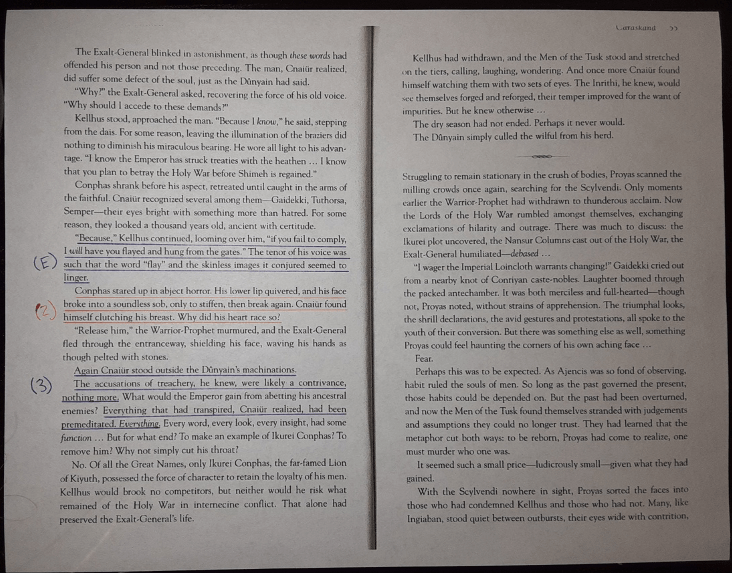
Kellhus begins, just as we see him do back in the first bookwhen he first speaks to Cnaiür, by explicitly laying out his target’s private reasoning as far as the target has thought his situation through. While Kellhus might seem to be tipping his hand by revealing what he knows, we can see why for him the benefits of this strategy might outweigh the costs. The purpose of this move is to put the target on the defensive – being seen through leads the target to feel uncertain and insecure, making it hard for him to think clearly. In this opening, Kellhus can then go on to add to the target’s chain of reasoning, pushing it in any direction he likes while presenting his as the only natural continuation of the logic. By not giving the target time to think his situation through any further for himself, in the target’s present state of confusion Kellhus’s continuation comes to seem like a part of the target’s own reasoning and logic (where Kellhus does this in the above excerpt is marked (A) in blue).
That done, Kellhus proceeds on to the first soul attack (marked (B) in green). This follows his usual MO of pointing out contradictions in his targets’ worldviews. In this case, he points out the contradiction between Conphas’s belief that he is a god and his inability to openly claim so. However, this attack fails, because Conphas lives too deep within his own narrative for Kellhus to really bother him with superficial contradictions. Conphas does not feel shame at all, and to the extent he feels pride, it is almost entirely unbound from the opinions of the men around him. At the end of the day, Conphas does not really care what people think about him, so he is not concerned much by the fact he cannot say openly that he is a god – knowing it himself is enough. Since Conphas only puts value on his own beliefs, and none on what others think of him, when Kellhus pits these against each other, Conphas’s own beliefs of himself simply win hands-down, leaving no contradiction to be concerned about.
This strategy having failed, Kellhus continues to pursue his second attack (marked (C) in purple), testing his theory of whether Conphas really is incapable of feeling shame. Cnaiür has noticed this section of the attack all along, since shame is one emotion Cnaiür feels in spades (marked (1) in purple). In fact, this attack is broad enough to be hitting the men of the Tusk as well as Cnaiür. Conphas, however, is unmoved – because of course, as Kellhus already suspects, Conphas simply does not feel this emotion at all. Cnaiür’s comments on this part of the attack are more distracting than enlightening, since he is then still pondering over the force of it (“For an instant he found himself inside the man’s lies.”) when Kellhus, who has been reading Conphas’s mind all along and watching his attack fail, has already moved on.
At last Kellhus comes to the third, and final, attack (marked (D) in red). He describes Conphas’s psychopathy as a “defect carried from the womb.” This attack is of course specialized towards Conphas and is not hitting the rest of the men of the Tusk (most of them, of course, not being psychopaths), and is not so simple for Conphas to walk off. Dismissing what is clearly based on a true observation is not easy – Conphas knows he is different from other people, he has eyes, but he’s always taken for granted his own interpretation of these differences. This attack, unlike the earlier ones, is not intended to convert Conphas to Kellhus’s side. Indeed, it need not, for Kellhus’s purposes, even have any immediate effect. In the short term, Kellhus knows he can force Conphas to leave simply by might of arms and appropriate threats, since Conphas is interested in self-preservation (see section marked (E) in blue).
No, the purpose of this attack is to subtly derail Conphas’s narrative in the long term. Conphas, who has always considered his differences from others to be a source of his superiority, is now presented with the view that they are rather a source of inferiority – and one inferior to others cannot be a god. Thus, in order to retain his own worldview, Conphas must alter his narrative to avoid Kellhus’s pitfall. In this, Conphas succeeds – while walking in the desert, he finds a version of reality with which he can be satisfied, and chooses to believe it. This effectively lets him shake off the soul attack without being converted to following Kellhus (and admit it, walking off three Dûnyain soul attacks is kind of impressive, especially for someone who doesn’t even know what a Dûnyain is). However, the more Conphas alters his narrative, the more his beliefs drift ever further away from reality. In the fire metaphor, Conphas is using his narrative to shield himself from the burning Truth, leaving him blind to his location in relation to it. So once he starts altering his narrative and course, he cannot see that as a result he is getting further and further away from the path. Conphas’s ability to change his beliefs through mere will makes his narrative robust enough to withstand Dûnyain soul attacks, but also allows him to interpret the facts any way he pleases, so that not only soul attacks but other Truths he might want to know also pass him by. Thus, Conphas does not see reality coming for his head until it is too late. Kellhus, understanding Conphas, knows that this is what will happen, and predicts accurately that Conphas is doomed even without him needing to get further involved.
We see confirmation of this interpretation in Bakker’s mirror metaphor. Did you wonder what was up with all the mirrors? This is what.
The mirrors start to appear in the scene where Conphas has sex with a slave, and he tells her to hold the mirror to look at herself. This is because she is human – she judges herself based on her reflection in the world, on how other people see her, and on how reality affects her. Conphas, however, considers himself a god – he judges himself based off of his own internal standards, not the judgments of the world. But after losing Martemus, and altering his narrative to defend against Kellhus’s third soul attack, he has lost the ability to keep his beliefs tethered to reality. He is not using the world as a mirror in which to see the Truth anymore, he has stopped using mirrors – in fact he has stopped validating his narrative against the world at all. But reality is not so easy to escape from.
Reality is hard and unforgiving, and narratives that don’t keep track of where the boundaries are, are bound to collide with it. The next mirror we come across is the table – the fact it is reflective is more than just an aesthetic choice of Bakker’s, it’s part of the metaphor (“It was carved of mahogany and so polished that, given the proper angle, it possessed a mirror sheen.”). Conphas is no longer adjusting his narrative, or image of himself (reflected in the table), in response to feedback from the world. Rather, he is allowing himself to interpret anything that happens as fitting within his narrative. He sees his image of the world, rather than the world itself – this is what Cnaiür means when he tells Conphas, “You make mirrors out of all that you see.” Thus, even when all his generals can see that Cnaiür is completely out of it, Conphas can only see his own beliefs about how things are, interpreting Cnaiür’s actions as part of his own story. But when reality, played by Cnaiür, slams Conphas’s head into the table, causing his real self to collide with his image of self, one must break. Since Conphas will not allow the image – the narrative – to change, the one to break is the Conphas in reality.
And yet, Conphas recovers from this initially, as he does from almost everything – one of the benefits of letting one’s image of reality be determined by mere will. Since Conphas is bound neither by Truth, nor by any sense of shame, he is not bound to the past in the same way as, say, Cnaiür himself. Note that while Conphas spends a few days hunting Cnaiür through the city, after Cnaiür escapes Conphas gets tired of the hunt and stops bothering, instead sending some subordinates after him, while himself going instead to betray the Holy War and pursue his real goals. On the other hand, Cnaiür, in not wholly dissimilar circumstances, throws away clan and ultimately (perhaps) life in a 30+3 year quest for revenge. Cnaiür, we see, has little ability to keep events from influencing his narrative.
Why didn’t Conphas kill Cnaiür immediately once he found him, though? Well, just because Conphas can keep external events from changing his narrative, doesn’t mean he is inviting them to try and counter it. Consider: Conphas believes himself a god, and it is one thing for a god to be beaten and raped by a literal demon, another for it to happen at the hands of a mere mortal Scylvendi barbarian. Cnaiür can prove mortal only by dying, so as long as he still lives, both Conphas’s and Cnaiür’s identities as divine incarnations remain intact.
But while Conphas’s narrative allows him to continue pursuing his goal of betraying the Holy War, that does not mean there are no consequences from these events. As his narrative gets driven ever further away from reality, it cannot find its way back, and Conphas cannot see that his side is losing until reality comes with a sword and cuts his head off. Alas. Personally, though, I don’t think it was a bad death. So many others died believing in Kellus’s lies, serving him unquestioningly even as he used their lives as mere tools. At least Conphas died fighting his enemies, believing in his own divinity and not Kellhus’s. Even if he had run back to Nansur, his days would probably have been numbered with Kellhus yet determined to rule the world of men. Level fives are at a distinct disadvantage against level sixes, especially level sixes with sorcery.
So much for Conphas’s arc.
VI.
Why, though, does Cnaiür do what he does? And how much of the proceeding events does Kellhus really predict? To find the answer, we must again consider the scene excerpted above (which, after all, was from Cnaiür’s perspective, even though it was about Conphas and Kellhus, and Bakker would not have written it this way without reason). How, we ask again, does Kellhus know that after kicking them out together, his two enemies will not join forces against him?
Kellhus tells the entire Holy War that Conphas is planning to betray them to the Fanim. Cnaiür hears this just like everyone else. Why, then, does Cnaiür not take precautions against this imminent betrayal (or join Conphas in it, for that matter)? And how does Kellhus know beforehand that Cnaiür will be taken by surprise by this obvious development?
Back at the start of the second book, Kellhus asks Cnaiur a question:
“Not everything I say,” the Dûnyain said, “can be a lie, Scylvendi. Why do you insist on thinking I deceive you in all things?”
“Because that way,” Cnaiür grated, “you deceive me in nothing.”
Cnaiür’s logic here is, of course, a fallacy, which Kellhus, logic-expert that he is, instantly realizes. In typical Dûnyain fashion though, he does not point this out to Cnaiür, and merely files it away to use against him later. The fallacy is this: if someone always lies, reversing what they say will always give the truth. But what if someone only lies most of the time, but is free to speak truth if they wish? Reversing everything they say, then, will often lead to truth, but sometimes will still lead to lies. By believing everything Kellhus says to be a lie, Cnaiür opens himself to being tricked – Kellhus simply need tell the truth. By stating openly that Conphas is planning to betray the Holy War, Kellhus practically guarantees that Cnaiür will not question Conphas’s loyalty, and will be taken wholly by surprise when Conphas’s ships sail up to the harbor (see section marked (3) in blue).
But how does Kellhus know that Conphas will not reach out to Cnaiür himself, and offer him in on the conspiracy? It is because Kellhus knows that Cnaiür will alienate Conphas first.
At the beginning of the above scene, while Cnaiür is watching Kellhus address the Holy War, he notices Kellhus looking at everyone, including him (“[Kellhus’s] luminous eyes roamed the room, stirring gasps and whispers wherever they passed. Twice his look found Cnaiür, who cursed himself for looking away.”). After this, Cnaiür stops paying attention to where Kellhus is looking – but we might reasonably assume that Kellhus does not stop looking, just because Cnaiür doesn’t take note of it anymore. Thus, any thought Cnaiür has during the rest of the scene, we might reasonably assume Kellhus has read off of him, including those marked (2) in orange. Bakker is not without attention to detail.
Kellhus knows, we can see, what is going to happen – he has been reading the thoughts of his enemies all along and extrapolating. He knows Cnaiür will attack Conphas. He knows Conphas will not see it coming because he is too deep in his own narrative to notice threats any longer. He knows Conphas will betray the Holy War and thus Cnaiür, and the resulting battle will whittle down both their forces.
But wait. Didn’t Kellhus tell Cnaiür to kill Conphas? How did he know Cnaiür wouldn’t just do that before they got to the port? For that matter – why didn’t Cnaiür just do that? My best guess is that Kellhus knew that Cnaiür would be ill-disposed to do anything Kellhus ordered him to do, especially after Kellhus had just finished betraying him by kicking him out of the Holy War.
This sort of plan is exactly what we might expect of Kellhus, whose general attitude is, why kill two birds with one stone, when you can turn the birds against each other and get them to tear each other apart, thus saving yourself a stone?
So it’s clear why what is about to happen is a surprise to Conphas, and not a surprise to Kellhus. But why is it a surprise to Cnaiür? I mean, if he’s the one acting, shouldn’t he have, well, seen it coming? But – is he really the one acting?
Cnaiür gives Conphas and the reader a reason for why he does what he does:
“I am a demon!” he cried. A demon!”
This, Cnaiür/Bakker tells us, is the literal explanation. Well, you know you’re deep in the metaphor when even your literal explanations require literal explanation. And so we ask – what is meant by this? How is Cnaiür defining the term “demon”?
To understand, it is informative to go back to the first book, to Cnaiür’s explanation to Kellhus of why he helped Moënghus, which bears certain similarities to his explanation here:
“I was possessed!” he snarled. “Possessed by a demon!”
The difference here, is that in this case he is telling Kellhus that during the time he worked for Moënghus he was possessed by a demon, whereas in the scene with Conphas he is claiming to be a demon. Is it, perhaps, the same demon? Is it, in fact, Cnaiür at all that is claiming to be a demon in the latter scene – or is it instead the demon itself announcing its presence in Cnaiür’s body?
Considering Bakker’s theories of mind, we find another layer of interpretation to Cnaiür’s dual personality. Cnaiür, we might guess, has blackouts because he has two personalities, created when he met Moënghus and split his masks, but grown separate from each other after he rejected the original “inner” personality. But what, then, happened to the inner personality? It didn’t go away. Cnaiür never consciously inhabited it, true. But under Bakker’s philosophy, beings do not need consciousness to act – in fact, consciousness is necessarily inhibitive.
Although the concept is more clearly expressed in Neuropath, sticking with The Thousandfold Thought, we might consider Meremnis’s discussion of volition:
Of all the Cants, none better illustrates the nature of the soul than the Cants of Compulsion. According to Zarathinius, the fact that those compelled unerringly think themselves free shows that Volition is one more thing moved in the soul, and not the mover we take it to be. While few dispute this, the absurdities that follow escape comprehension altogether.
This is one of the absurdities that follows – that consciousness does not act, it simply observes while believing itself to act. Thus, Cnaiür’s second personality is perfectly able to act on its own, without him consciously choosing anything it does – and because he chooses not to observe it, he cannot remember the long stretches of time while it is acting. This not-personality is what Cnaiür calls a demon, that from his perspective is possessing him, when what is really happening is that he is simply abdicating his consciousness when alternate neural pathways he does not want to acknowledge are acting. I would guess he uses the word “demon” because it seems a fitting designation for any entity that acts maliciously and whose motives are opaque. Other characters often call Kellhus a demon for exactly this reason, and Peter Watts in Blindsight (post upcoming) uses this word in all three of the senses noted here as well.
Cnaiür’s attainment of this unconscious state has other effects, besides leaving him with long periods of unexplained blackouts and little control over his own actions. It even has benefits. Consider – Kellhus’s Dûnyain face-reading works best on conscious beings, as most humans are. But, when Cnaiür’s second personality acts, not being conscious, it doesn’t reflect on what it is going to do, it just does. This is how Cnaiür manages to take Kellhus by surprise when Kellhus comes to kill him after Anwurat. Kellhus is trying to read his outer, conscious personality, while it is the cognitive pathways of the inner that are moving his body. This is what gives him certain anti-Dûnyain abilities, and what allows him to take Moënghus by surprise at the end.
And this is the final sense that Cnaiür/Bakker means when not-Cnaiür claims he is a demon – he is acting without consciousness, inhumanly.
VII.
So, we see that Kellhus knew all this would happen – that Conphas and Cnaiür would attack each other, that these attacks would both take the other by surprise, and that conflict between them was inevitable.
What, though, did Kellhus expect the end result of this conflict to be? Certainly, he would benefit from them wearing down each other’s forces. But who did he expect to win? Or did he predict that both would escape?
We know his predictions did not extend to the expectation that Cnaiür would escape and join the Consult, as evidenced by his surprise when while talking with Aurang he notices that Cnaiür has revealed Kellhus’s secrets to him (“Track, it had said…The Scylvendi. I should have killed him.”). My best guess is that he expected Conphas to kill Cnaiür. Kellhus probably calculated that Conphas would have more forces and thus win, even though he would still take considerable losses.
In fact, Kellhus may even have been hoping that Conphas would kill Cnaiür, and thus do what Kellhus was apparently unable to do himself. Wait – Kellhus, unable to do something? Impossible! And yet, we see a bit of a pattern in the relationship between Kellhus and Cnaiür. That pattern goes something like this: Kellhus teams up with Cnaiür because he has a use for him. That use ends. Kellhus decides to kill him. Kellhus changes his mind. Cnaiür betrays Kellhus’s secrets to someone else. Kellhus regrets. Cycle repeats.
Consider: At first, Kellhus is just using Cnaiür to guide him to the edge of the mountains, and plans to kill him after that. But by the time they get there, Kellhus has talked himself out of it. Then Kellhus decides to kill Cnaiür after he’s finished talking him into betraying his secret knowledge of war by the rainbow-thirty-years-method-of-malicious-metaphor. At the last moment, however, standing in the ocean holding his sword to Cnaiür’s neck, Kellhus changes his mind again. Not very Dûnyain like now, is it?
Kellhus, we see, has somewhat more sentiment remaining to him than he likes to pretend. He doesn’t usually have emotions, but when he does, he finds them startling, like walking into your kitchen only to find a wild animal sitting on the countertop.
Kellhus stood motionless above him.
What is this, Father? Pity?
He gazed at the abject Scylvendi warrior. From what darkness had this passion come?
One racoon in your kitchen is a fluke. After the third or fourth, though, you have to start wondering whether you perhaps left a window open somewhere.
Kellhus, we see, simply cannot bring himself to kill Cnaiür. “There were other uses. There were always other uses.” Rationalizations (from a Dûnyain!). Soon after, Cnaiür betrays Kellhus’s deception to Proyas, inconveniencing Kellhus. But nonetheless, after the Umiaki strategy, when Cnaiür has once more outlived his usefulness, Kellhus still cannot bring himself to kill him outright, sending him away instead – at which point Cnaiür promptly betrays his secrets to the Consult. Kellhus can only gnash his teeth in regret when Aurang shows up knowing more than Kellhus had intended. And ultimately, of course, Cnaiür also betrays Kellhus’s secrets to Achamian (not that Kellhus is particularly inconvenienced at that point though, having already won).
Unfortunately for Kellhus, Conphas decides against killing Cnaiür since he needs him alive for narrative-supportive reasons, as discussed above. The mantis stalks the cicada, unaware of the oriole behind – but there’s no point being the oriole if you’re not prepared to kill the mantis.
VIII.
Given these definitions of god, demon, and prophet – which of them, then, should we expect to be the most powerful?
Consider Aristotle’s dichotomy, mentioned here previously:
Anyone who either cannot lead the common life or is so self-sufficient as not to need to, and therefore does not partake of society, is either a beast or a god.
A beast – or, say, a demon – by this definition, is one who “cannot lead the common life.” Consider Cnaiür, unable to fit in with Scylvendi society – “most violent of men” – someone who has shrugged off the very borders of humanity, able to act without the limitations of consciousness that make men human.
A god, by this definition, is “so self-sufficient as not to need to…partake of society.” Consider Conphas – he lives in his own world and does not need the affirmation of others, nor care about their scorn. He does not need human connection. He lives almost entirely within his consciousness, having lost those bonds with reality that keep men human.
Where does Kellhus fall in this spectrum? He seems to fit into both categories. He is able to give up consciousness and personal will when it suits his purposes, for example when using the probability trance. But he also has mostly given up emotion and human connection. These sacrifices give him power over reality, even while separating him from it. He does not fit into society so much as fit society to him, he does not partake but takes. What is he then, a beast or a god?
Or something else – something more than either? A monk? A prophet?
Humans have a duality about them – consciousness and control balanced with passion and instinct, god balanced with animal within their souls – and the balance, Bakker shows us, limits them. Conphas, Cnaiür, and Kellhus have each given up something of their humanity, but in doing so gained something that made them more than human as well. Does everything come at a price?
Can these contradictory aspects of humanity not be reconciled in some way – combined, so that they become more in the holder, rather than less, something that clashes without yet cancelling? If Kellhus is indeed a true prophet, or something more, it is because he has found a way to unite these elements, consciousness and instinct, emotion and reason, and become something greater than either gods or demons – something greater than even Dûnyain?
 Literal Explanation Required