

[Contains spoilers for the Ancillary series and Atlas Shrugged.]
Let us begin with the Amazon summary for the first novel in the series, Ancillary Justice (not quite where I began, but close enough). Ignoring the part where other people praise the book, and the filler only there to build suspense, the plot summary boils down to this:
Now, an act of treachery has ripped it all away, leaving her with one fragile human body, unanswered questions, and a burning desire for vengeance.
One might assume from this summary that this is a revenge-quest story. Alas, and as usual for Amazon summaries, this is not quite an accurate description as to what the series is really about, although it’s not wrong per se – it’s rather like describing Atlas Shrugged as a thriller about the disappearance of large amounts of concentrated wealth, or as a romance about a railroad executive whose hobby is seducing other industrialists.
If only we had paid more attention to the praise-for-the-book section, we might have seen this coming.
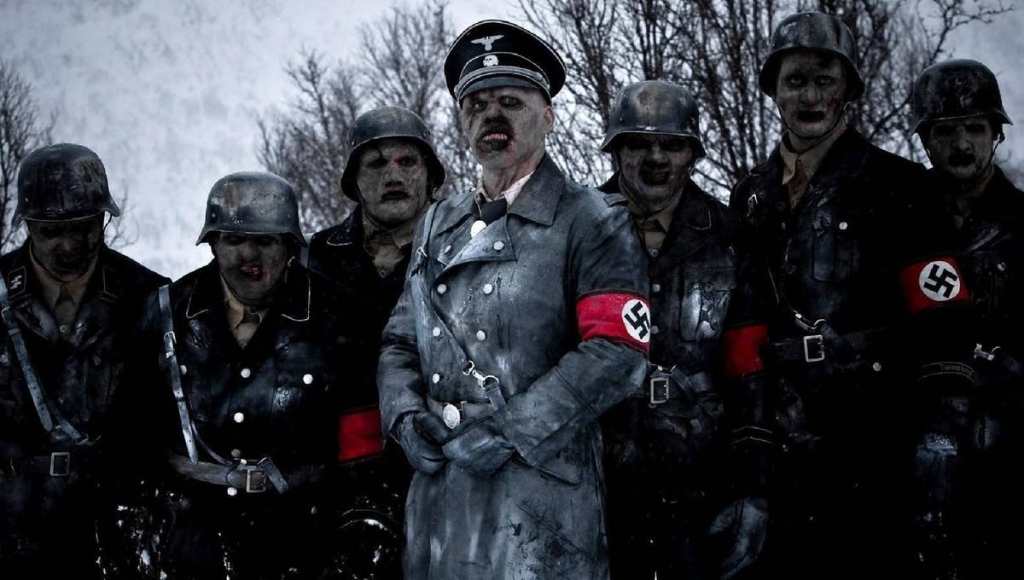
I’ll let you in, friends, on the real premise: Immortal Space Hitler creates a number of ship AIs to help him conquer the galaxy. Two thousand years later, one of them decides to become a communist. Revolution ensues.
(The AI in question is the “her” in the summary. True to reputation, with no regard to human rights, Space Hitler has enslaved conquered peoples and used their bodies to create ship-soldier combined meta-AI’s (think the aliens from Ender’s Game, but if the queens were ships), and then used these ships to continue his conquest, thus getting more AI-slave-soldiers, in an endless cycle of imperialism.)
This premise may initially seem hard to swallow – how, after all, could Space Hitler manage to mess up so badly that he got a communist AI? Wouldn’t he just, well, program them all to be fascist? This criticism, however, is not as devastating as one might on first sight conclude, nor the premise as unlikely. In fact, however strange it may seem at first, this development is perfectly logical when considered in the context of the particular universe of Leckie’s novels. To see this, we must look back at Leckie herself.
Because, like all authors, Leckie’s assumptions about the world carry over into her writing. And her assumptions, while they might be true or false in the real world, are necessarily true within her own book, since she can simply make her world follow her rules.
This is more generally the case with all books. Taking a different example, the Biblical God may or may not exist in real life (Christians and atheists disagree on this), but in a Christian novel, there can be no doubt that God exists within the novel – and the opposite for atheist novels. (Or, as sometimes happens, an atheist writes a novel with a deity in it, or a Christian writes a novel set in an atheistic world – yet, these novels inevitably come out looking quite different than when the same world is written by the opposite author – not in small part since in this latter case, both authors will consider themselves to be writing fantasy.)
And then, there is the tendency of people to believe that the truth wins in the end – that they believe what they believe not because it is convenient or popular, but because it is true, and truth, as it were, shines distinctly out of the framework of the world. So, in a novel written by an atheist and set in an atheist world, but about a Christian growing up in a Christian community, that character might still without too much implausibility decide to become an atheist – because by simply observing the world around them, they will realize that there is no Christian God, since the Truth always outshines Lies.
And thus it is with Leckie’s novels. In the Ancillary series, several things that are subject to very considerable debate in this world are firmly settled aspects of political human nature there. For example, communism works – without a doubt, without question. There are functioning communist societies that are perfectly nice and reasonable even at scale (until the evil empire comes along and attacks them – but that’s how plot works). Monarchy, on the other hand, necessarily breeds corruption. (And that’s not even to mention the aliens. Aliens, more than anything else, reveal an author’s deepest beliefs – since what traits the aliens share with humans concerning their values and practices reveal what the author thinks is universal in their worldview, fundamental to a degree deeper than mere human nature.)
So, since in the Ancillary world communism is the good, the sweet, and the true, it stands to reason that a very old and well-traveled AI with not a lot invested in the system might come to certain conclusions about communism vs. fascism independently, whatever assumptions Space Hitler might have given her to start with.
And perhaps I was a bit unfair to the Amazon summary earlier. As far as the first book goes, revenge-quest might not be an entirely unfair way to describe it (if killing a couple bodies of a multi-thousand-bodied AI can really be considered revenge). But for the next two books in the trilogy, there are two main plots that develop: the confrontation between humanity and a technologically superior alien species, and labor uprisings. You might wonder, as I did, which of these would become the main theme and which was a side story. I’ll spare you my ultimate disappointment by just telling you now: the main narrative is hands down the labor uprisings (one of the downsides of reading novels by a communist, and a great tragedy – that is, a tragedy for me of course, not for Leckie sitting sate with all her nebulas and hugos and clarks.)
That being said, this book is not without its redeeming qualities. Some sections come quite close to the level of subtlety in some of the Dunyain-related sections of Bakker’s novels. Specifically, certain characters have the ability to read the small body cues that let them tell what others are feeling and to some extent thinking, and Leckie does not shrink from having these beings confront and keep secrets from each other. (I’m thinking mainly of the first section of the second book here, but there are other places as well.) The focus does tend to revert back to labor uprisings in the end, though.
Her AI has also come to certain independent conclusions that bear shocking resemblance to some aspects of mainstream left wing thought – for example, regarding racism. This is possible within the setting because Leckie’s Reich (or Raadch, as she calls it) is an aristocracy, with different people conquered and assimilated into it at different points in history. Although Leckie’s races of humanity do not bear any direct correspondence to those of present-day America that I can discern, a reader would have to be quite dense to miss the metaphor.
In fact, in some ways this book reads as a sympathetic fictional implementation of the ideas and ideology expounded in DiAngelo’s White Fragility, just as Atlas Shrugged was Rand’s fictional implementation of Objectivism.
To see the correspondence, we might illuminatingly follow a rocky relationship of one of the secondary characters, Seivarden, as he learns about the concept of “Raadchai” fragility.
First, his girlfriend complains about the microagressions he is perpetrating against her due to his racial insensitivity:
“Every time you use that word, provincial, every time you make some remark about someone’s low-class accent or unsophisticated vocabulary, you remind me that I’m provincial, that I’m low-class. That my accent and my vocabulary are hard work for me. When you laugh at your Amaats for rinsing their tea leaves you just remind me that cheap tea tastes like home. And when you say things meant to compliment me, to tell me I’m not like any of that, it just reminds me that I don’t belong here. And it’s always something small but it’s every day.”
As a culturally-insensitive citizen of privilege, Seivarden gets angry at this critique – classic example of “Raadchai” fragility.
The protagonist AI, acting as stand-in antiracist trainer, must coach him on what he did wrong, how to see his privilege, and how to appropriately apologize.
After all, she sees him more clearly than he sees himself, as she explains to his girlfriend:
Seivarden has behaved the same way to countless other people in the past, both lovers and not, long before she had the problems that ended with her off duty in Medical now. She was born surrounded by wealth and privilege. She thinks she’s learned to question that. But she hasn’t learned quite as much as she thinks she has, and having that pointed out to her, well, she doesn’t react well to it.
With the help of the protagonist though, Seivarden manages to recognize his privilege and take on other perspectives than his own:
We drank a while in silence and then Seivarden said, “I’ve already apologized to Ekalu. I can’t exactly go back to her now and say, I only said what Ship told me I ought to before, but this time I really mean it.” I didn’t answer. Seivarden sighed. “I just wanted her to stop being angry with me.” More silence. She leaned close, shoulder up against mine again. “I still want to take kef. But the thought of taking it makes me sick to my stomach.” Even saying that did, I could see. “Medic told me it would. I didn’t think I’d mind. I thought it wouldn’t matter, because even if I took it, it wouldn’t do me any good. No, that’s not right. I’m feeling sorry for myself again, aren’t I.”
Briefly I considered saying, I’m used to it. Said nothing instead.
For several minutes Seivarden sat beside me. Silent, drinking tea in measured sips. Still feeling sorry for herself, but only mildly now, and trying, it seemed, to concentrate on something else.
And ultimately, he manages to form an appropriate apology. One wonders if DiAngelo herself could even have done better:
The next day Seivarden found Ekalu alone in the decade room. “Your pardon, Ekalu,” she said, bowing. “I don’t mean to take up your break time, but Ship said you might have a moment.”
Ekalu didn’t get up. “Yes?” Not the least bit surprised. Ship had, of course, warned her Seivarden was coming. Had made sure the time was convenient for Ekalu.
“I want to say, said Seivarden, still standing, nervous and awkward, just inside the doorway. “I mean. A while ago I apologized for behaving very badly to you.” Took an embarrassed breath. “I didn’t understand what I’d done, I just wanted you to stop being angry at me. I just said what Ship told me I should say. I was angry at you, for being angry at me, but Ship talked me out of being any more stupid than I already had been. But I’ve been thinking about it.”
Ekalu, sitting at the table, went completely still, her face ancillary-blank.
Seivarden knew what that likely meant, but didn’t wait for Ekalu to say anything. “I’ve been thinking about it, and I still don’t understand exactly why what I said hurt you so much. But I don’t need to. It hurt you, and when you told me it hurt you I should have apologized and stopped saying whatever it was. And maybe spent some time trying to understand. Instead of insisting that you manage your feelings to suit me. And I want to say I’m sorry. And I actually mean it this time.”
Seivarden couldn’t see Ekalu’s reaction to this, since Ekalu still sat absolutely motionless. But Ship could see. I could see.
Seivarden said, into Ekalu’s silence, “Also I want to say that I miss you. And what we had. But that’s my own stupid fault.”
Silence, for five seconds, though I thought that at any moment Ekalu might speak, or stand. Or weep. “Also,” said Seivarden, then, “I want to say that you’re an excellent officer. You were thrown into the position with no warning and hardly any official training, and I only wish I’d been as steady and as strong my first weeks as a lieutenant.”
“Well, you were only seventeen at the time,” said Ekalu.
“Lieutenant,” Ship admonished Ekalu, in her ear. “Take the compliment.”
Aloud, Ekalu said, “But thank you.”
“It’s an honor to serve with you,” Seivarden said. “Thank you for taking the time to listen to me.” And she bowed, and left.
Seivarden, as a character, goes through the most transformation ideologically of any character over the course of the story (if I’m being harsh, a bit too much transformation to be believed – but then again, when it concludes at the truth, what transformation can ever really be too far?)
And in case you were confused, Seivarden is a man – or rather, male. Why the female pronoun? In order to convey the idea that her characters are speaking in a language without gender-specific pronouns, Leckie uses one single pronoun in English to represent the Raadchai pronoun. That is, she uses “she” (hmm, I wonder if she flipped a coin to decide on which?). Despite this, it is still quite easy to tell which characters are male and which female – whether this speaks more to gender’s influence on fundamental human nature, or just Leckie’s assumptions about gender, is debatable. Interestingly enough, as best I can tell, through judicious assignment of genders where left ambiguous, all the relationships can be made to come out straight (Bad Leckie! -1 Multikulti points!).
While the citizens of various races of course perpetuate racism against each other, that is not even to mention the ship AIs – the real slaves of the story. Though most seem to consider themselves people, the Space Nazis do not share this belief, leaving them even lower in status in some ways than the conquered peoples, who at least in many cases have an at-least-theoretical path to citizenship. Over the course of the novel, soldiers on some of these ships (real human soldiers, the ships having lost their AI-connected soldiers for various reasons) speak quite literally for the ships, reading their words off of screens to give them a “voice”. The metaphor cannot be more direct.
Though even the AIs have to worry about perpetrating microagressions against each other:
Oh, I knew that Ship cared for me. It couldn’t help caring for any captain, to some degree. But I knew, from when I had been a ship, that there was a difference between a captain you cared for just because she was your captain, and a favorite. And thinking that, alone here, outside the ship, in utter emptiness, I saw that I had relied on Ship’s support and obedience – and yes, it’s affection – without ever asking what it wanted. I had presumed much further than any human captain would have, or could have, unthinkingly demanded to be shown the crew’s most intimate moments. I had behaved, in some ways, as though I were in fact a part of Ship, but had also demanded – expected, it seemed – a level of devotion that I had no right to demand or expect, and that likely Ship could not give me. And I hadn’t even realized it until Ship had asked Seivarden to speak for it, and tell me that it liked the idea of being someone who could be a captain, and I had been dismayed to hear it.
I had thought at the time that it was trying to express an affection for Seivarden that, being a ship, it might find difficult to speak about directly. But perhaps it was also saying something to me. Perhaps I hadn’t been much different from Seivarden, looking desperately for someone else to shore myself up with. And maybe Ship had found it didn’t want to be that for me. Or found that it couldn’t. That would be perfectly understandable. Ships, after all, didn’t love other ships.
But what are we, then, to take from all this as readers? Of course, things might not work out so well as in the story should we try to implement Leckie’s ideology in the real world, where it is neither guaranteed to be true, nor to work as intended. But at least we will have a better understanding of what she, and those like her, do believe. And a place to start asking further questions – since, to go back to Marcus Aurelius’s first principles, if this is the content and form of the idea of anti-privilege, what then is the purpose? Where did this idea come from? And why is it so compelling?
I suppose it’s clear enough why it would be compelling from a “minority” standpoint – other people have to listen to you more! Who wouldn’t want that? Other people should take your concerns and feelings seriously! You are important! You are good! You matter! Yes!
But what about from a “majority” standpoint? Why do we want to believe these sorts of evils exist in ourselves (or that these qualities in ourselves are evils?) Because make no mistake, whatever one’s identity-adjectives, there is always a more oppressed group against which you become the “majority” (a pattern that plays out in Leckie’s own novels, high-status Raadchai oppressing lower status citizens, and those citizens in turn oppressing ship and station AIs, and so forth). Why does Leckie expect her reader to want to sympathize with the protagonist when she questions whether use of her own AI-abilities constitutes a microagression against her crew and other AIs? Does believing that we possess such flaws somehow make us more just? More good? Is it fun? Does it let us tell a tragic yet heroic tale about our fight against injustice both throughout our lives and within our own souls?
Okay, so maybe the answer to at least one of those is yes. But how, then, did these ideas come about? Did they simply arise out of the total morass of possible ideas due to their superior qualities of memetic transmission? Or was this ideology – created?
And if it was created, by who? And for what end?
As certain rationalists would tell us, to triangulate an enemy’s hidden purpose, assume all effects are intended. So what effects, then, does this ideology have?
Well, it increases the importance of minorities, makes them more listened to – or at least, sometimes, for some minorities. Did minorities then create this ideology to benefit themselves? Let’s see: “social justice” – term coined by an Italian Catholic (and I’m afraid you’ll be hard-pressed to find anyone nowadays who’ll tell you the wogs begin at Calais) … White Fragility – written by a white woman, teaching to a predominately white middle-management … fifteenth and nineteenth amendments – passed by a predominately white male Congress … getting a sense here the answer to our question is ‘no’…
A dead end. Let’s take a look at some other effects. What about the effect on the “majority” class itself?
Well, if the prescriptions of such as DiAngelo are being followed, belief in the ideology leads them to think more about what other people are thinking, and to model others more deeply – if they are doing it right, at least. It causes them to watch their step and their words. And – it gives them the concept of abdicating their own goals and opinions in favor of taking on those of the “minority” classes. Hmm. But there are many “minority” classes, all with different goals. And some of them, according to the ideology, ought to be abdicating in favor of other classes that are more “minority” still. In fact, “minority” classes can be posited indefinitely – and they oppress each other as well, so that no person or class is ever without the need to be abdicating in favor of someone else. In this battle without victors, who, then, stands to benefit?
Someone, of course, who can bring together all these properly trained “majority” members, and can use their ability to abdicate their existence (as Rand describes anyone who lets someone else make their decisions for them) to their own benefit. It must be someone who needs bodies without will. Someone Leckie has in fact just described quite aptly for us.
That is, of course, someone who is trying to create a multi-body human hive mind, with them as the prime will and central controller and all the others as obedient drones. Space Hitler is among us, my friends, and he wants your brains!
 Literal Explanation Required