
[Contains spoilers for The Thousandfold Thought.]
In response to Coronahell, the US government instituted two main rules (besides the lockdowns, which at least in the US, have mostly ended). These rules are:
1. Mask requirements
2. Face-to-face meeting limitations
The stated purpose of these rules is to prevent the spread of disease. But assume, for a moment, that there is a deeper goal. What might this goal be?
At first glance, this might seem a difficult question, since the two rules appear to work at cross-purposes to one another, serving neither the interests of a faction in power nor a dissident faction.
That is, consider the situation from the perspective of a surveillance state, say, that of O’Brien from 1984. Banning gatherings, of course, is same-old-same-old. If the dissidents can’t meet, the dissidents can’t talk, and if they can’t talk, they can’t conspire against you. If they do meet, well, now you have a perfect reason to arrest them. (Or if they meet on Zoom, now the NSA knows everything they’re saying. Not that they didn’t know before, what with people carrying their cell-phones around everywhere, but maybe the Agency got tired of the poor sound quality.) Mask requirements, though, are another story. For O’Brien, facial recognition software is on his side. When everyone has an excuse to go around with their faces covered, and most do, the technology becomes error-prone if not useless. Alas for O’Brien, selling the populace on ankle monitors is going to be an uphill battle.
The two rules appear just as contradictory when taken from the other side. Take the perspective of, say, Saul Alinsky, attempting to coordinate dissident activity in support of the Eternal Revolution. His people are then the ones going out to oppose the government, cause unrest, and break the law. For them, mask rules are a gift sent from heaven – when even the people just passing the protests to buy groceries have to wear masks, no one will be able to figure out who to arrest, no matter what sort of camera-salad they may have to snack on. Anonymity, for them, is a shield, and in a world in which it was starting to seem an anachronism, a little piece has just been given back. But banning face-to-face meetings is another story. No movement can move without holding a few meetings, and now every one they attempt to coordinate is automatically suspect. Not to mention that all public gatherings must necessarily be held outside, making attendance highly dependent on the weather. And while Alinsky may control a lot of things from behind the scenes, the weather is not one of them (yet). This latter policy is clearly not beneficial to his continued activities.
And yet, both rules are widespread. So, how did the US end up with this contradiction in policy? A moment’s thought, though, reveals several ways this apparent paradox can be reconciled.
Possibility #1: One Is Two
That is, the rules seem to be working at cross-purposes because they are working at cross-purposes.
Wait, what? But the same people made both rules – why would they oppose themselves?
Of course they wouldn’t. But what if, what appeared to be the actions of one entity, were in fact the actions of two different entities hiding behind a single mask?
When the motives suddenly don’t add up, it can be helpful to consider the possibility that you are in fact looking at some other number of factions than is immediately apparent. One way this can happen is if multiple factions are in fact controlled behind the scenes by a single agent. The other way is for what appears to be a single faction to actually be the public face of two or more agents with different goals, both unwilling to throw away the mask, but equally unwilling to let go of an opportunity to thwart the other.
For illustration, consider the Holy War. Seemingly random attacks, assassinations, and battles are constantly occurring, that Proyas and Conphas have no good unifying explanation for. Everything that went wrong gets blamed on the Fanim, because that is the enemy they know about, just as right now everything that goes wrong in the US gets blamed on the bureaucracy or on Trump. But that is just the narrative – the real factions lay concealed behind the narrative.
The real factions, in the case of the Holy War, are the Dûnyain and the Consult. Both of these factions want the Holy War to successfully march on Shimeh. But they are still enemies, and thus both at each others’ throats whenever they can get away with it without getting discovered – that’s why all the confrontations between Kellhus and Aurang tend to happen during the battles with the Fanim, when everyone else is too distracted to notice.
The Dûnyain and the Consult both don’t want anyone else to know that they are the real forces controlling the Holy War from within the shadows, so they don’t dare be too open about what they’re doing – they refrain from attacking each other if it would derail the whole Holy War, or sow doubts in the minds of the rank-and-file. But while they both want the Holy War to reach Shimeh, what they want after that diverges quite rapidly. Thus, the choices made by the leadership of the Holy War, supposedly a unified entity, become erratic and irrational from an outside perspective. This is because the leadership is in fact being controlled collectively from within by two separate hidden entities with conflicting desires and goals. Both of these entities are (mostly) rational individually, but modeling their combined actions as those of a single faction leads to an irrational picture.
In the case of the US then, we might postulate that the deep state has two factions (at least), both of which are attempting to control the government from the inside. Both wish to turn the government’s actions to their own purposes, but neither can afford to go too far when acting against the other, for fear of the mask being torn away and revealing the true nature of the US government to a horrified (and well-armed) US populace. (The Holy War, one might note, was also well-armed.)
If this is true, then the present situation could be something along these lines. One faction, for example, might be attempting to conduct covert ops on US soil. This faction, then, would benefit from instituting and popularizing the mask requirement, allowing their operatives to better hide among the unsuspecting civilians (facial recognition software, recall, was getting quite good before the virus hit the ventilator). One doesn’t need a mask requirement to go about wearing a mask, sure. But if only “covert” operatives and a couple international students (some of whom are also, perhaps, covert operatives, though for a different power) are wearing them – well, their enemies don’t need to recognize faces then to tell the ones wearing wool from the ones growing it. Only when everyone is wearing masks do said enemies have a problem.
The opposing faction cannot outright reject the mask-requirement without casting doubt on the whole Coronanarrative by the sudden reversal – and this they don’t want, since even if this narrative is where their enemy’s power comes from, it is also the source of their own power. The Coronanarrative was created and allowed to propagate because it served the purposes of both factions, and removing the mask-requirement at seeming-random would threaten that narrative. Instead, like an improv-actor, the other faction must advance the narrative starting from its current trajectory, but taking it in some other direction to achieve their goals. Thus, we get the meeting-ban – supposedly for the same purpose as the masks, it really serves to obstruct the operatives of the other faction from holding meetings and gatherings, or at least make it more difficult for them to move inconspicuously. Neighbors who call the police on anyone with an extra car in their driveway have now all-unwittingly become the new secret police.
The next obvious question to ask is, what might be the identity of these two factions? State and Pentagon? Or something new under the sun?
It’s hard to say without knowing what the real purpose behind the coronavirus was. Was it created in a lab? Or just a chance occurrence amplified in its effects by deft control of the public narrative? Is it really a coincidence that just as vaccinations are starting up, new, more virulent strains are being discovered? If it was made in a lab, then mixing up a few more strains probably isn’t too hard. And if it only exists in the simulacra – then one can declare as many strains into existence as one pleases, as long as each fits properly into the arc of the story. (Do you think deceit would be discovered and published? But published where, and by whom? And how many people have access, really, to that level of information? And of those, how many are reliably honest? Remember your Lippmann. Public opinion is related to the reality of direct observation only through the most tenuous of threads.)
Possibility #2: They Walk Among Us
But what if the government is run only by a single faction? Rules one and two must then have been created for the same purpose. Assuming that purpose is to hamper the movements of an outside faction, we might then by deduction hypothesize about what the nature of that outside faction must be.
A moment’s thought brings to mind one very obvious outside faction these rules would do well combatting.
Consider, for a moment, the hypothetical scenario in which Cnaiür told Proyas the true nature of the Dûnyain from the start. Proyas, then, instead of blindly following the whims of faith, decided to root out the enemy from within his own ranks. How might he have gone about it? (Or if this seems too unlikely, imagine Conphas with full knowledge of the Dûnyain.)
Universal mask requirements would make it much more difficult for Kellhus to walk about reading the minds of everyone he passed. And meeting restrictions, while difficult to implement in a war, would where practiced have prevented the gathering of wide-spread support by would-be demagogues. Kellhus first gains power by forming a cult of personality – that is, by speaking personally to people and groups to convince them of his divinity/expertise/charisma/etc. If no one can gather, forming cults just got a lot more difficult.
Thus, for those seeking to war against Dûnyain, masks and meeting-bans aren’t a bad place to start.
The implication of the US’s current adoption of these two policies immediately becomes clear: the government has discovered Ishuäl.
(My bet is that they happened on it while searching the Colorado mountains for the lost gold of Atlantis stashed away in the Coffers.)
Seriously, though, we might do worse than to consider what sorts of entities operate on similar rules to those of the Dûnyain, and that the US government hates even more than it loves its own precious GDP.
Possibility #3: Masks As Catch-22
But then again, even from a more basic perspective, are the two rules so contradictory after all? I admit, dear reader, I engaged in a bit of casuistry earlier when I implied there was no easy way the rules could be complementary.
Look again at the situation from the perspective of a government trying to suppress dissident factions. The meeting ban’s purpose is clear enough, as I discussed above. And the mask requirement, perhaps, only seems contradictory on the surface.
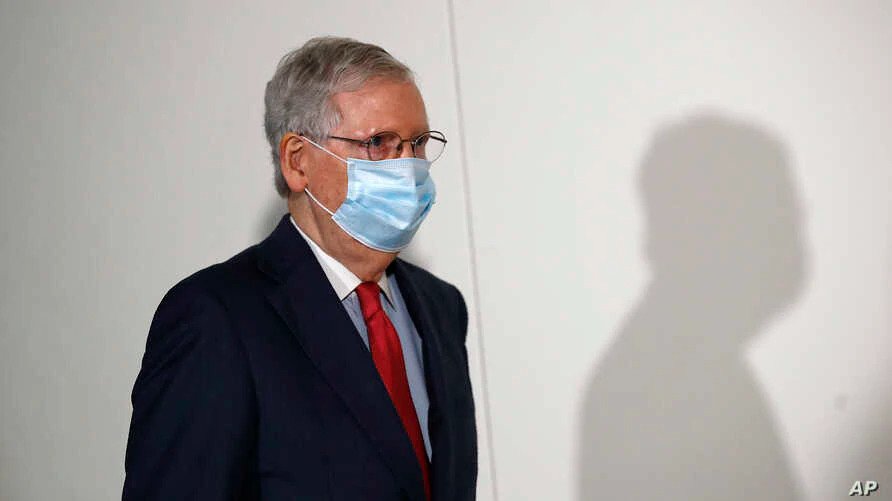
Consider. If wearing a mask is government-required, then anyone who wears one marks themselves as someone who supports the government. In order to signal dissent, one would then have to go about not wearing a mask.

And the problem not-wearing-a-mask creates for dissidents is that it leaves them open to getting flagged by facial-recognition technology. So if they don’t wear a mask, the government knows they are dissidents. If they do wear a mask, then they look like government supporters. Thus, public dissidence is de-incentivized, everyone wears masks besides true crazies, and the government appears to have the support of the entire populace – as if there is effectively no dissident section of the population. The masks rule becomes self-reinforcing.
Dissidents now have two choices: either go completely private, or completely public. The middle ground has been cut away.
The effects of pushing some ideas into the realm of the completely-private, I discuss in the next section.
As for those who choose to cast away anonymity and publicly pick a side – well, better hope you chose the right one, because there’s no going back, and like Bakker’s world, this one isn’t big on second chances.
Possibility #4: Welcome the Sixth Age of Men
Whatever the true reasons for these rules, we might consider independently their effect on the population. Corona restrictions have not, I think, started a trend that is entirely new, but rather form the continuation and acceleration of something that has been going on for at least a few decades, and perhaps very much longer indeed.
We all live behind masks, people used to say. Only now, it’s true literally, not just metaphorically.
Recall the past decade’s discussion about the effects of social media. People lamented the distance between those whose friendship existed solely or primarily through a computer screen. Facebook put users a keyboard’s length away from everything they said and did on the website. And while something was lost from that distance, a sense of deep personal connection perhaps, something was also gained. That is, perspective was gained, a perspective from which one could post selectively, write judiciously, and overall present oneself the way one wanted to be seen. On Facebook, everyone is two people: the person presenting themselves on the page, and the person sitting behind the computer. That is, everyone now could have the same two faces as any Dûnyain (or as Cnaiür managed to semi-successfully cultivate, though only with the assistance from something even more malicious than Facebook).
Most people, not being Dûnyain, find it difficult to achieve these results in person. They can’t control their facial expressions, moment-to-moment words, and everyday actions as if they are operating an avatar. Everything is too close, too immediate. Only with social media to supply that added distance and time to think can they achieve something similar.
But what if one only meets people very rarely, or through a computer screen? And what if the few meetings one does have in person, half one’s face is hidden? Could you hide or control, say, half your expression?
(They say social media kills your soul – it doesn’t. It only disconnects your surface personality from that soul, hiding it away from enemies and journalists. Having more layers does not make you less of a person. It makes you more.)
This is the intermediate step people needed to take the lessons they learned from social media and bring their skills to the next level. If left to cook long enough, even once the masks are off and the Zoom is off – the split will remain. Everyone is now two people, an inner and an outer. We live in a world of pseudo-Dûnyain.
This is the fourth possibility, the fourth possible goal for corona requirements one and two. Someone in the government is instituting these policies in order to accelerate this development in the population. They are playing Moënghus to a country of Cnaiürs.
Why such a world might be desirable, or to whom, is another question. A population of pseudo- Dûnyain is a lot of things, but docile and easy to control is probably not one of them. (Not that everyone will be Cnaiür-level insane, that’s only what happens if you mess it up.) But it creates a population of competitors. When those at the top are the only ones with two faces, they are the only ones with four eyes in a world of biclops. They are the only ones that can truly See. But when everyone has those two extra eyes, things become more complex.
Why, then, encourage such a development? Perhaps the true leadership has opened yet another eye, and become bored of ruling a comparatively blind population. Or perhaps there are two factions in competition, each thinking to gain a leg up on the other by recruiting from a larger awakened pool.
Perhaps the gods have discovered it takes something more than mere mortals to fight the Consult.
Or else, perhaps the old factions, however many they may have been, however many eyes they may have seen through, have encountered a new threat, taken too lightly for too long until it was too late. Now in their death throes, they see the end approaching fast. Even knowing it is too late for them to be saved, as a final, parting shot they are now sacrificing the very means by which they held power for so long to deal their terminal enemy one final blow. In a last desperate act of defiance, they have opened the source and spigot of their power to the masses, knowing that only those already awake cannot be awoken – those and the dead.

 Literal Explanation Required